

Our Mens, Manus and Machina (M3S) program partnered with Singapore’s Infocomm Media Development Authority (IMDA) to host the MIT-Singapore Symposium on Embodied and Scaleable AI.
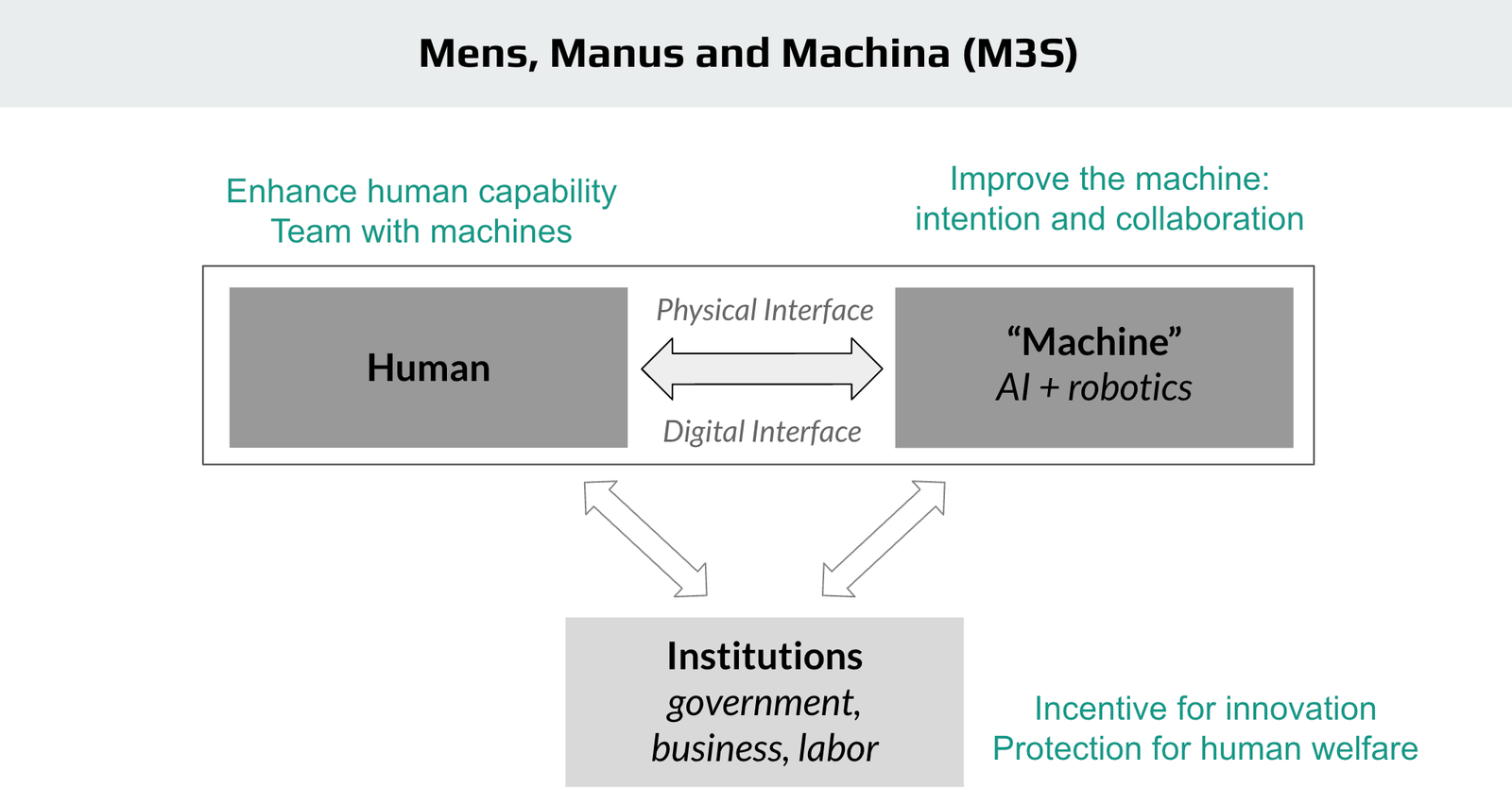
At M3S, we explore two essential questions:
First, the interaction between humans and machines
- How can we improve the machine—to better understand human intentions and collaborate with us?
- How can we enhance the human—by building the skills and habits necessary for success in an AI- and robotics-rich environment?
Second, we study how to adapt our institutions (governments, businesses, and labor systems) to create the incentives for innovation while safeguarding human welfare.
I offer three reasons why “embodiment” is central to the future of AI
#1: AI enables robotics. Embodiment, in turn, deepens AI.
In the past five years, we’ve witnessed extraordinary AI feats: mastering Go, predicting protein structures, and drafting IPO prospectuses.
Yet these advances emerged in disembodied environments.
- They show us what AI can do when the world is passive.
- They do not show us what happens when the world pushes back!
—from gravity, friction, to human emotions and social norms.
Place a language model in a kitchen, and it must learn that “on the table” is not a string of tokens but a physical constraint.
Drop a navigation robot onto the rainy streets of Singapore, and it must reason what slippery means and being soaked in water may short its circuit.
Embodiment is a reality check.
It is not just about having a body.
It is the capability to act in the world, learn from consequences, and engage meaningfully with other agents—especially humans.
AI enables robotics. Embodiment, in turn, deepens AI.
#2 Embodiment as a scientific instrument
Throughout history, science leaps forward whenever we invent new instruments—Galileo’s telescope, Hooke’s microscope, the Large Hadron Collider.
Embodied AI is emerging as such an instrument of similar significance, one that lets us probe the nature of intelligence itself.
Why treat a robot as an instrument?
Because it’s an executable hypothesis.
Each time it grasps or misses, makes a human uncomfortable or delighted, it tests assumptions about perception, memory, motor control, and social cognition.
Nature is a very good verifier.
#3 Embodiment brings A.I. closer to humans
Human experience is fundamentally embodied.
We don’t only manipulate symbols; we act and feel.
Our language is full of physical metaphors:
- We “grasp ideas” because we grasp objects.
- We “weigh our options” because we weigh physical items.
- We “turn a corner” in thinking because we’ve done so physically.
We use our own body as a simulator to answer questions. It grounds our cognition.
If we want AI to collaborate with us, it must share our bodily common sense.
Three M3S Research Tracks
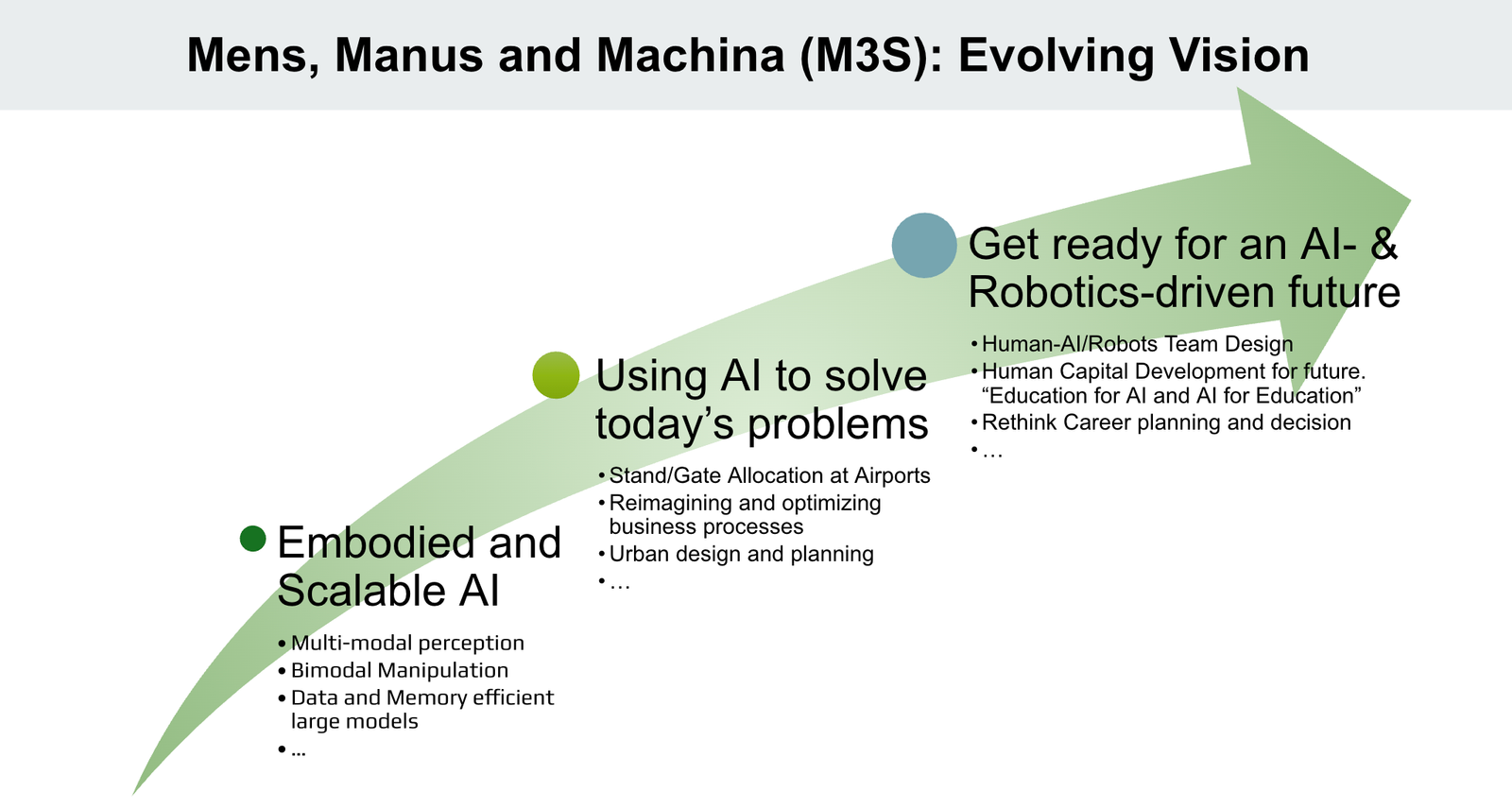
At M3S, we conduct three types of research
1️⃣ Foundational Science on AI and Robotics
Embodied AI, Scalable AI, Multi-modal Perception
2️⃣ Using AI to Solve Today’s Problems
Airport resource allocation, optimizing business process, enhancing city design
3️⃣ Preparing Society for an AI Future
AI for human capital development, imagining alternative urban futures, Human-AI team design
I’m deeply grateful to the incredible M3S team for making the symposium a success.
🔗 Learn more about the M3S program: m3s.mit.edu
🔗 Explore the Embodied AI Symposium: m3s.mit.edu/julysymposium28july

Here are the slides about the M3S program, and three reasons why “embodiment” is central to the future of AI.