Public transit in the United States is at a difficult time: the looming “fiscal cliff” (the exhaustion of federal emergency relief funds that provided a lifeline to agencies during the COVID-19 pandemic), shifts in travel patterns both spatially and demographically, labor shortage and aging infrastructure, social issues such as homelessness, mental health, and crime being dramatized in the transit system.
Despite these formidable challenges, leaders from two of the nation’s largest transit operators, Chicago and San Francisco, are embracing the crisis as a catalyst for innovation and focusing intensely on service quality and securing diversified future funding.
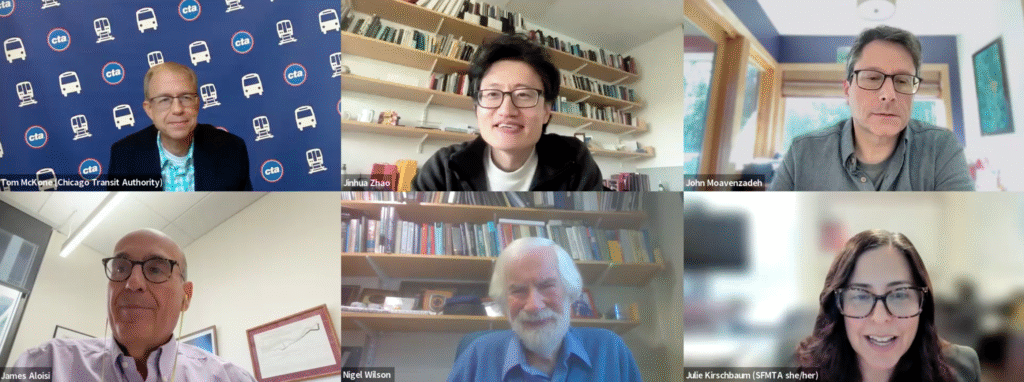
Here is what I learned from my conversations with Tom McKone from Chicago and Julie Kirschbaum from SF at the MIT Mobility Forum.
CTA (Chicago Transit Authority) with Tom McKone
Adapting to New Ridership Patterns:
• Usage Patterns:
While the total ridership is lower than pre-pandemic, the same number of actual people are riding over a 30-day period; they are riding less frequently.
Ridership on Saturdays and Sundays is nearly back to what it was pre-pandemic influencing CTA’s investment strategy.
• Service Adaptation:
To meet off-peak demand, CTA launched a Frequent Bus Network in 2025, guaranteeing 10-minute or better frequencies during midday weekdays and most daytime hours on weekends.
• Staffing & Modernization:
CTA hired 5,000 people in the last two years, nearly half of whom were bus operators, to restore service lost during the Great Resignation.
The $2.2 billion Red Purple Modernization (RPM) mega-project resulted in double-digit ridership growth at its new, accessible stations.
The Fiscal Reality:
• The Structural Gap: The CTA projects an ongoing structural gap of $451 million.
• Cost Structure: Labor is the dominant expense, consuming two-thirds of the CTA’s budget.
• Efficiency: CTA’s administrative overhead is the lowest in the industry, reinforcing that the fiscal cliff cannot be solved by cutting administration. New revenue is necessary to fill the gap and provide service.
• Revenue Action: CTA plans a 10% fare increase, the first since 2018, noting that riders “would rather pay a little bit more than see you cut service”.
SFMTA (San Francisco) with Julie Kirschbaum
SFMTA/Muni is the 8th largest transit system by ridership and is unique because it integrates Muni with the city’s Department of Transportation.
Ridership and Operational Quality:
• Disparate Recovery: Bus downtown ridership is almost 75% recovered, while the rail system is only in the low 40s. The resilient bus system is better able to change and modify service to emerging travel patterns.
• Innovation:
SFMTA implemented Muni Forward, delivering over 75 miles of transit lanes and signal priority, which makes the bus more competitive with driving.
The agency moved to headway management strategies, rather than following rigid schedules, using technology to keep vehicle spacing consistent and giving operators information digitally on how close they were to the bus in front of them.
• Maintenance: By shutting its subway down early (9:30 PM once a quarter) for deep maintenance, SFMTA reduced long delays by 50% and short delays by 70%.
• Customer Satisfaction: In 2024, SFMTA achieved the highest customer satisfaction ratings ever been in the agency’s history.
The Funding Crisis and “Three-Legged Stool”:
• Systemic funding gap: Relative to the awesome transit system in the Europe or Asia, U.S. transit is just not sufficiently funded to deliver these types of systems. California provides a “very small state investment” relative to cities like Chicago or Boston.
• Impacted Revenue: The shock of COVID impacted all of SFMTA’s traditional funding sources (fares, general fund, parking revenue). Revenue from its largest downtown parking garage is anticipated to drop from 20 million per pear to only 6 million.
• Inability to Cut: “There is no scenario where public transit right now can cut our way out of the fiscal cliff” 77% of the budget goes to direct service provision (operators, mechanics, custodians, etc.)
• Funding Plan: SFMTA is pursuing a three-legged stool approach: a new five-county funding measure (covering 40% of the challenge), a complementary local parcel tax, and continued cost reductions.
Remarks by Prof. Nigel Wilson
• Optimism and Crisis: Nigel “resonate[s] with the message of optimism”. The stress and threat created by the pandemic have accelerated innovations that were already underway.
• Rethinking Service Quality: He praised the agencies for rethinking what constitutes high-quality service, citing the focus on walk-up service, high frequencies, and increased off-peak and weekend service.
He specifically liked the headway management strategies discussed by Kirschbaum, recognizing them as a crucial response for high-frequency routes.
• Bus Service Improvement: the importance of using signal priority and the “careful allocation of the scarce street space to buses” to improve the quality of bus service without requiring additional rail investments.
• Organizational Structure: Europe has more recognition that a public authority should make policy and planning decisions, while operations may not need to be provided by the same public entity. He suggested this is an idea that might emerge from the U.S. industry’s crisis.
• Smaller Markets: while Chicago and San Francisco are “very strong public transport markets,” the challenges faced by smaller metropolitan areas are “even greater”. For these markets, the industry may need to think about “more radical restructuring” regarding the role of public transport.
Remarks by Jim Aloisi
• Transit Adaptation: He highlighted a shift in trip purpose in Chicago, noting that “more people are using CTA for mobility of care purposes than they are to get to work”.
• Perception vs. Reality: Aloisi emphasized the challenge of addressing the public’s perception of safety and fare evasion, which often intersect. He stated that the reality is “it’s a lot less safe to drive than it is to take transit,” but perceptions often become reality. He also noted that frequency of service plays into these perceptions, as standing at a stop for a long time increases the perception of being unsafe.
• The Larger Value Case: Aloisi stressed the need to make a case for transit’s value beyond access to jobs, connecting it to shared urban values such as public health outcomes (reducing particulate matter emissions), economic recovery and growth, reducing greenhouse gas, and transportation justice. He asserted that “you can’t do any of those things without a highly functioning transit system. You just can’t”.
• Road User Charging: While Aloisi does not expect an “explosion of road user chargers across the country” soon, he views the declining gas tax as inevitable. His message to agencies is that they need to be “planning now” to ensure they are “foremost in the conversation” regarding future road user charging. This charging needs to be understood as a “more adaptable and robust source of revenue that transit agencies will benefit from.”