

Intuition suggests “yes” because it eliminates commuting.
Reality: not necessarily.
- Commuting fell, but total travel did not.
The TTI Urban Mobility Report: US traffic congestion in 2024 reached its worst level ever since the measure started in 1987.
- Commuting energy consumption vs. home and office energy consumption
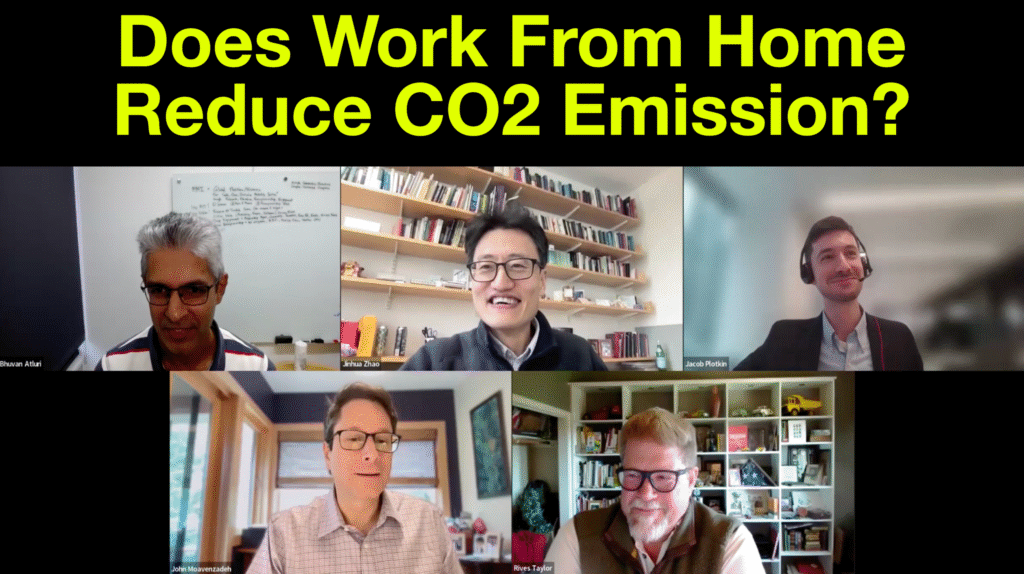
I hosted Rives Taylor and Jacob Plotkin from Gensler and Bhuvan Atluri and John Moavenzadeh from MIT Mobility Initiative to share the findings of our joint study “The Carbon Impact of a Workday.”
Key points by Jacob Plotkin
1. Dual timelines of decarbonization
- Structural/Long-Term: energy grids, building codes, urban form, and transit availability, top-down systems driving emission variance, and changes happen slowly
- Behavioral/Short-Term: Immediate and measurable through individual behavior, commute mode, how much space is occupied, and whether homes are set back during the day
2. Efficiency of Space
• Per person, offices are much more carbon-efficient than homes.
• Square feet per person: 150 ~ 250 (office) vs. ~ 650 (multifamily) vs. 1,000 (single-family)
3. Setbacks
- Home setbacks:
Mild (30% reduction): adjusting HVAC (80°F cooling / 67°F heating)
Aggressive (60% reduction): turning off HVAC, lights off, reducing plug loads, and placing appliances on standby.
Feasibility: 100% is impossible due to safety concerns (like pipes freezing or food spoilage) or family members. Close to half of people can comfortably do aggressive setbacks during the workday.

• Office Setbacks: up to a 50% reduction, but requires organizational decisions, such as closing down entire floors or sections during periods of non-occupancy.
4. City Specific Findings

5. The most impactful action depends on grid cleanliness and urban form.
- Dense/Cold/Dirty Grid (Chicago): Aggressively setting back the home

- Sprawling/Car-Centric/Warmer (Houston): Shifting away from private gas cars to public transit, biking, or walking:

- Clean Grid (Los Angeles): Switching to an Electric Vehicle

Key Points by Rives Taylor
1. Carbon reduction is maximized when using shared infrastructure.
• Office Efficiency: Working in an office provides the “value of scale“
• Residential Efficiency: multifamily beats single-family, even for the same square footage, due to efficient operations and the building envelope maintenance.
2. Tyranny of Convenience: “always available, just in case” keeps systems on all the time: a major systemic inefficiency preventing carbon reduction
3. Technology is ready; behavior lags.
Most post-2000 buildings (due to a major U.S. building code shift) are technologically ready to implement setbacks. But corporations are behaviorally failing to implement energy reductions.
◦ Lighting and Ventilation: light sensors; CO₂/occupancy-based economizers to reduce the intake of outside oxygen for ventilation. LEDs shrink lighting’s share of energy use.
◦ Plug Loads: sensor-controlled strips to cut idle loads.
• Windows still debated: The rationale for sealed windows: operators fear people will forget to close them, leading to rain, humidity, loss of air conditioning, and mold. For operable windows: people feel better and tolerate wider temperature ranges, which can save more energy; also a safety necessity during outages.
• The Future of Office Design moves toward optimization through personalization.
Key Points by Bhuvan Atluri
1. Commute Patterns
• Most Americans drive alone. Carpooling is declining. Work From Home (WFH) has stabilized around 28%–29%.
• Commute patterns show substantial variations across cities.

2. Calculating Operational Carbon Emissions by Mode

• Gas Car: ~400 grams of CO2 per mile, based on the U.S. average fuel efficiency of 22.3 miles per gallon.
• Electric Vehicle (EV): ~144 grams of CO2 per mile, based on average U.S. grid carbon intensity.
• Public Transit: ~93 grams of CO2 equivalent per passenger mile, accounting for the mix of rail and bus types and lower occupancy rates than in Europe.
• Bike Share/E-Scooter: ~33 grams of CO2 per mile to account for vans rebalancing
• Biking/Walking: zero carbon emissions
3. Scope
• This report focuses on Operational Carbon to spotlight near-term behavioral shifts. Future analysis: embodied carbon, from manufacturing vehicles or construction of infrastructure/buildings.
• The report does not examine Non-Commute Trips, recognizing the complexity of the “substitution effect”
4. The Interactive Calculator lets everyone customize (city, housing type/size, heating method, commute mode/distance, office days) to simulate carbon footprint.
Audience Comments (Misc from various members; no specific attribution)
- The lack of scenarios involving office setbacks “realistic but disappointing”.
- Offices seem intent on being fully cooled and heated regardless of occupancy
- Some argue many office buildings are “ill-prepared to modulate HVAC”
- The calculus of working from home extends beyond carbon: time and childcare
- Knowledge work is “decoupled” geographically, making WFH sensible for collaborating globally.
- Home setbacks constraints: concerns on the risk of pipes freezing; disabled persons, pets, or older relative at home; people in multifamily lack individual control; the inconvenience of bringing a house back to a comfortable temperature after an aggressive setback
- Many workers cannot work from home (e.g., Walmart employees, hospital nurses, service workers, and domestic workers)
- Apply the analysis to suburban areas, smaller Tier 2/3 towns.
- Decisions are often driven by immediate cost/benefit, rather than carbon.
- Relying on individual behavior is insufficient. “Individual behavior as an answer to systemic problems” is problematic and will fall short.
Final remarks by Jinhua Zhao
1. The Danger of “Everywhere, Every Time” Operation
A pervasive trend of seeking “extreme flexibility”.
- Space: work at home, office, and the third place.
- Cars: used 5% of time but “I need it available all the time”
- Parking: ~300M vehicles in the US; 700M – 2B parking lots (2.5~7 parking spaces per vehicle)
- Stuff: everyone needs 12 water bottles and 20 cups.
Abundance is marvelous unless at the price of the ecosystem.
The industry is happily pushing in this direction.
If humanity does not impose constraints upon ourselves, “the ecosystem will be the final constraint.”
2. Narrow-Minded Optimization is Dangerous
It is a truism. More specifically, minimizing transportation emission in isolation may increase the total system emission.
The transportation system exists to allocate urban activities more optimally across space, “enabling a high-level optimization of the broader urban system.”
Appendix: The Carbon Impact of a Workday
————–
Besides research at JTL, M3S and MMI, I have two passion projects:
- I help cities with transit, AV, and AI: pls join my Newsletter
- I help youth learn scientific research and build critical thinking Scientific Inquiry Mastery