

While the public often associates car innovation with OEMs, much of the technological progress originates from Tier-1 suppliers: Magna, Bosch, Valeo, Denso, and OP Mobility, etc.
The relationship between Tier-1s and OEMs had been relatively stable; but no longer.
Cars are becoming more software-defined, connected, and computational.
The focus is shifting towards Advanced Driver Assistance Systems (ADAS) and Autonomous Driving (AD).
Tier 1 suppliers are now facing pressure from both ends:
◦ From the top: OEMs are developing and owning their own software.
◦ From the bottom: High-tech companies and chipmakers (like Nvidia, Qualcomm, and Mobileye) are moving up the stack to offer full-platform solutions.
Tier 1s face a dual challenge:
- defending the high-volume L2 ADAS market to generate current revenue
- while simultaneously funding high-risk, high-cost R&D for L4 autonomy
A delicate dance between OEMs, Tier-1s, and high-tech chipmakers
Each redefines its place in an ecosystem that is at once collaborative and competitive.
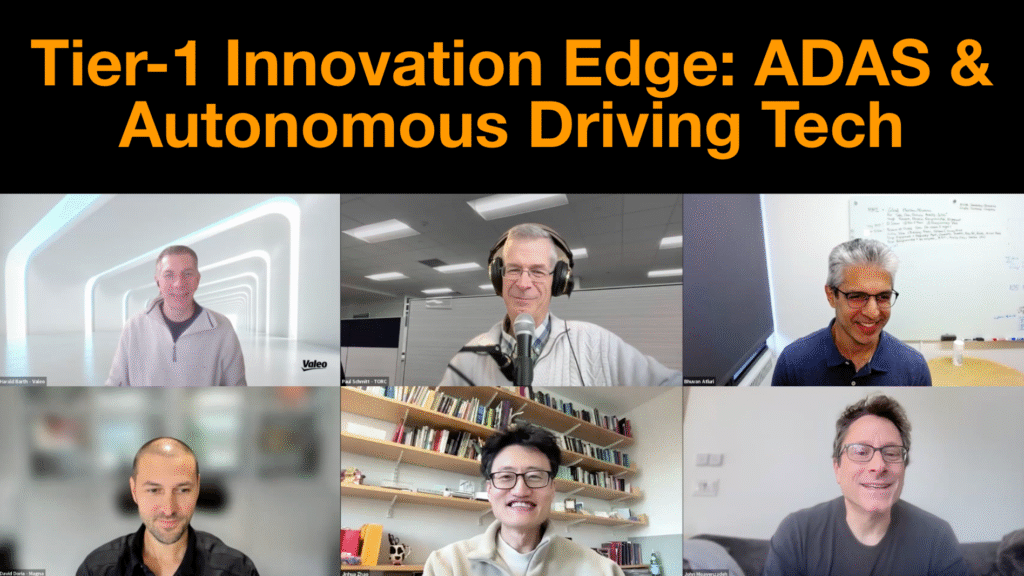
Bhuvan Atluri , John Moavenzadeh and I hosted three experts from the Tier-1s to discuss sensor fusion strategies, ADAS/AD stack integration, business models for ADAS/AD, impact on safety, and future product lines.
- Paul Schmitt , Torc Robotics (a Daimler subsidiary)
- David Doria , Magna
- Harald Barth , Valeo
Key Messages from Paul Schmitt from Torc Robotics
Core Focus and Mission
• Torque focuses on L4 autonomous long-haul trucking.
• Core product Virtual Driver, a fully integrated software and hardware solution running on an automotive-grade, redundant compute stack.
• Goals: make L4 autonomous long-haul trucking a scalable and profitable reality.
Emphasize safety first, reliability, and operational efficiency. Targeting a product launch next year, followed by scaling shortly thereafter.
Challenges in Automated Freight
• Duty Cycle & Thermal Management: Long-haul hours and highway speeds (65–75 mph) place extreme design constraints on the vehicle’s compute, power, and thermal systems.
• Sensing Range: The heavy weight (up to 80,000 pounds for Class A trucks) leads to longer stopping distances, longer range sensing down the highway corridor.
Platform and Hardware
• Multimodal sensor architecture: cameras, long/short-range LiDAR, and long/short-range radar to build a robust, high-resolution model and understanding of the environment and surrounding actors.
• Weather robustness (e.g., radar seeing through rain and LiDAR helping through fog) and handling dust storms common on their Texas routes.
• OEM Integration and Redundancy: The sensors and actuation systems are fully built into the vehicle by Daimler Truck.
Cascadia trucks incorporate redundant steering-by-wire, braking-by-wire, and throttle-by-wire systems validated for fail-operational behavior.
• High-Performance Compute: partnered with NVIDIA and Flex for automotive-grade, high-performance compute platform.
Designed for manufacturability, robustness across the full temperature range, and resistance to vibration rigor associated with commercial trucks.
• Raw Data Fusion: prefer raw data from the sensors instead of processed objects, leverage their high-performance compute
Software and Safety Innovation
• AV 3.0 Software Blueprint
1. End-to-end Reinforcement Learning (RL)
2. Heuristic Guardrails: rule-based guardrails enforces basic rules of the road and enables traceability and verifiability.
3. Modular Transparency: enabling introspection (inspecting inputs and outputs at the module level) to facilitate debugging and validation, avoiding a “full black box” approach.
• Machine Learning Failure Modes and Effects Analysis (ML-FMEA) methodology.
Apply safety principles to the machine learning development pipeline.
Published at the SAE World Congress and helped create a common vocabulary for the machine learning and safety engineering communities.
• Safe Machine Learning Collaborative: a group of companies to further develop the approach, anticipating it may evolve into a standard in the future
Final remarks:
• Societal Integration:
Works closely with policymakers, state, federal, and first responder communities to ensure deployment readiness.
The system must integrate not just into logistics, but into the transportation network and society at large.
• Industrialization:
The key breakthroughs are industrialization and safety, shifting from clever prototypes to manufacturable systems where compute, sensors, and chassis are designed together.
Key Messages from David Doria from Magna
Magna’s Scale and Role as a Tier 1 Supplier
• Scale: number one supplier in North America and number three globally. ~164,000 employees, ~$40 billion in sales, 337 facilities across 28 countries.
• Expertise: not only in design but also in production and manufacturing at scale.
Even seats contain over a hundred of microchips for features like heating, air conditioning, and airbags.
Portfolio: Sensors, Compute, and System Integration
• ADAS Sensor Portfolio: traditional cameras and radars (interior and exterior), as well as next-generation sensors like thermal cameras and imaging radars. Also perform LiDAR integration.
• System Integration (Tier 1 vs. Component Manufacturer):
OEMs increasingly prefer to work with Tier 1 suppliers who can provide fully functioning subsystems, or even full systems, rather than just individual components.
Magna’s integrator capacity: connecting sensors, computers, ADAS software stacks, and human-machine interfaces (HMI).
“Systems thinking” allows Magna to co-design products, such as integrating cameras into mirrors.
• Compute Power: Working with NVIDIA on the Thor platform. Increasing compute follows an almost exponential curve. Still far below the “trunk full of compute” in L4 systems due to cost constraints of production OEM cars.
Software and ADAS Feature Development
• Customer-Facing Features: Adaptive Cruise Control and Lane Centering are the visible “portal” customers see, as the result of the complex sensor and compute systems working together.
Many L2 features are becoming commoditized, appearing in inexpensive cars.
• Scope Creep in L2: L2+, L2++, L2.99
The SAE L2 description (lateral and longitudinal control simultaneously) sounds minimal.
But the industry is pushing L2 into sophisticated features like Urban Navigate on Autopilot (NOA).
It requires full perception stacks and drive policy for complex urban conditions, functionally similar to L4, but the driver retains legal responsibility.
• Future product lines: enhanced safety (e.g., V2X/connected ADAS for non-line-of-sight alerts), comfort (Highway and Urban NOA), and advanced parking features like Automated Valet Parking.
Sensor Fusion and Technology Shift
• Sensor Fusion transition from late stage (objects) to early stage fusion (raw data: pixels, point clouds).
• Shift to Centralized Perception: Early fusion requires higher bandwidth networks and more compute power. Send raw data to the central compute, allowing neural networks to create robust, unified environmental models.
• MLification: Machine Learning used in more and more parts of the system.
Business Model Observations
• Subscription Models: Magna intentionally disassociates itself from the OEM’s subscription model for ADAS features. Anecdotally, no consumers like the subscription model.
• HMI Ownership: OEMs want to own and develop the Human-Machine Interface (HMI) to ensure brand differentiation and control the driver “experience,” avoiding Tier 1 products looking identical across different vehicle brands.
Key Messages from Harald Barth from Valeo
Valeo’s Identity and Scope
• Three divisions: Power (electrification and powertrain), Light (seeing and being seen, including exterior lights, interior lighting, and wipers), and Brain (interior space, exterior sensors, perception, and driving assistance).
• > 100,000 employees and ~$25 billion in revenue last year
• Making mobility safe and more pleasant for everyone.
• One-stop solutions for parking assistance and safety & assisted driving, as well as perception & functions for automated driving.
• Active safety systems (like emergency braking, lane keeping, and adaptive cruise control)
• LiDAR perception systems: enabler for the first Level 3 systems in the market in Europe and the United States.
• ~30 million driving assistance/parking assistance systems every year
The Core Challenge of Automated Driving
• The fundamental challenge is the trade-off between Performance (zero missed/zero false detections) and Availability (Operation Design Domain or ODD). Two approaches:
◦ Approach A (Trustworthiness First): Focuses on achieving trustworthiness first, then expanding availability (e.g. Robotaxis like Waymo).
Challenge in downscaling for the mass market due to high engineering costs.
◦ Approach B (Availability First): Focuses on making the system available everywhere first, then working on trustworthiness (e.g., L2++ NOA systems).
Stepping from a supervised (L2) system to an unsupervised (L4) system requires a different architecture.
Technology and Innovation
• Multimodal Sensor Approach: ultrasonic, camera, radar, LiDAR, thermal (far infrared), and microphone sensors.
Each modality supplements each other and creates redundancy.
• Sensor Manufacturing: requiring micrometer precision while producing millions per year at constant quality.
Sensors must reliably work over a large temperature range and violent vibration, especially for applications like trucking.
• The industry faces “brutal, I call it Darwinian, cost pressure”.
Sensors must be high quality and robust, but also super cost-efficient. Valeo has shipped well over 2 billion sensors to date.
• ADAS Stack Coverage: sensors (to generate reliable data), hardware (scalable real-time compute), and AI Software (human-like driving policy).
• Software Approach: pure end-to-end approach is not a silver bullet. the system’s behavior needs to be explainable and predictable.
• Compute Hardware: providing high-performance computers:
from highly affordable solutions (using a smartphone camera for parking and safety features)
to central ADAS computers for vehicles like the BMW Neue Klasse.
A multi-domain modular central computer set to launch in 2028.
“Frenemies” Dynamics
Valeo engages in strategic partnerships with tech companies like Mobileye, Qualcomm, and Momenta (in China).
They are often collaborating with partners on one side while also competing in other cases, a “frenemies” dynamic.
Managing this requires openness, transparency, and trust while protecting intellectual property.
• Software-Defined Vehicle (SDV):
SDV puts hardwares into the vehicle as a standard, which doesn’t help the upfront cost issue. It allows one-off purchases, subscriptions, or pay-per-use models.
• Human Element: it’s really the people that make the difference, highlighting the need for the right people with the right education and motivation.
Key Comments from the Audience
1. Cost, Affordability, and Ethical Dilemmas
• Repair Costs: ADAS devices are noted as “so expensive to be fixed if they are broken”. They are also “most likely thrown away” if the vehicle is involved in a crash, particularly if a radar is involved.
• Affordability Challenge: The audience was concerned about the increasing cost of cars, noting that technology progress has “not been translated into affordability”.
The average new car price in the U.S. recently surpassed $50,000.
• Subscriptions and Ethics: There was significant debate regarding “ADAS as a service”:
◦ One perspective: providing features via subscription is logical to support “continual OTA maintenance and improvement updates”.
◦ Opposing view: ADAS “cannot be an add-on software feature” because “safety cannot be realized through subscription”.
◦ Ethical dilemma: limiting software functionality (when the physical sensors exist in the car) “feels immoral” compared to accepting that a cheaper car does not have the hardware in the first place.
2. Technology, Sensors, and System Architecture
• Sensor Durability: percentage of external sensors fully functioning in all weather conditions (e.g., snow, rain, dust) and what measures are taken to protect the most sensitive sensors (LiDAR, Radar, Cameras).
• Urban Challenges: the limitations of LiDAR in dense urban environments, such as high-rise buildings interfering with location accuracy (geofencing).
• Compute and Energy: The high power requirement for autonomy; the need for “much bigger GPU” and the resulting thermal management challenges (heat dissipating material).
3. Infrastructure, Policy, and Vehicle Specifics
• Infrastructure changes are needed in the road and signage network” that DOTs manage to improve autonomous sensing and performance.
• What “enabling policies” cities should implement to encourage the availability and performance of autonomous driving systems.
• HMI/UI: lack of discussion regarding the User Interface (UI), observing that OEMs generally want to “own/develop the HMI” to provide the unique “experience” to the driver.
Besides research at JTL, M3S and MMI, I have two passion projects:
- I help cities with transit, AV, and AI: pls join my Newsletter
- I help youth learn scientific research and build critical thinking Scientific Inquiry Mastery