

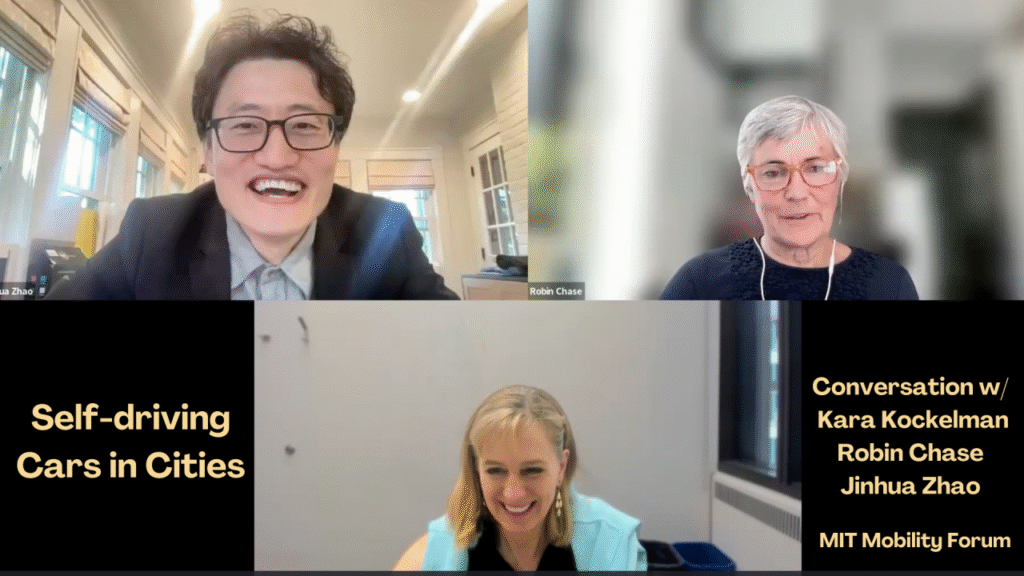
MIT Mobility Forum hosted Jinhua Zhao , Kara Kockelman and Robin Chase for a conversation on AV deployment in cities on Oct 3, 2025.
Key points by Jinhua Zhao
1. Automation Application Layers
There are three distinct layers where automation is applied:
- Public Transit
- Fleet-Based Shared Services
- Privately Owned Cars
While Asian and European Cities such as Singapore prioritizes automation in public transit, the U.S. focuses on fleet-based shared services.
2. Measuring the right thing (link)
Calculate the Passenger to Vehicle Ratio (P2V ratio) and use it benchmark AV performance against private cars, Uber/Lyft/Taxi, dial-a-rides, suburban buses, urban buses, or subways, for specific times and locations.
How would this P2V ratio change after Waymo 10x operation and move into lower-density, suburban areas?
3. AV fleet vs. Human car fleet: Dictating vs. Incentivizing Behavior
While Uber can only incentivize behavior through pricing and information, Waymo can dictate AV behavior.
With this 100% control of AV fleet, we can implement
• Regulating Speed Variation in addition to Speed Limit: Beyond traditional speed limits, AVs could manage speed variation, which is a major contributor to accidents but has historically been unenforceable.
• Dynamic Bus Lane: AV can be inserted into bus lanes when there are large gaps in bus schedules, a concept long discussed but impossible to enforce for human driven cars.
• Precise Pickup and Drop-off (PUDO) location management.
• Dynamic Parking: location specific and time specific pricing for parking, which has previously been difficult to enforce.
4. From Congestion Pricing to Direct Routing:
For human driving cars, congestion pricing is used to mitigate externality. With AV, the system can directly route AVs to reduce congestion, CO2 emissions, or crashes, serving as an alternative to conventional congestion pricing.
AV as Traffic Controller: In addition to managing AV themselves, AVs could function as moving traffic lights or policemen to regulate overall human driven traffic.
5. AV and Human Agency (link)
The Agency Frontier: the interface between human preference and machine intelligence, classifying AV decision-making into three levels:
• Low Level: Decisions like acceleration, deceleration, and lane changes, which users are willing to forego to the AV.
• Mid Level: Decisions concerning route choice or departure time.
• High Level: Choices such as single ride versus pooling, destination selection (e.g., an AV routing a user to a vegan restaurant for health reasons), or ownership choice.
The Command Matrix: the need to identify the right actor in charge (consumer, operator, car maker, or authority) for various scenarios, including normal operation, mega events, accidents, and emergencies.
6. Tension between states and cities concerning AV regulation (link)
• Deja Vu of Disruption: similar to cities’ conflict with Uber in San Francisco 10 years prior, though Waymo is behaving much friendly today.
• Conflicting Principles: States push for streamlined, scalable, and uniform policy frameworks, while cities argue that context matters and consequences are inherently local: livability, congestion, transit ridership, local enforcement, and equity goals
• Cycle of Inaction: The fear of state preemption often leads to a “self-fulfilling trap” and a negative cycle of inaction among many cities.
7. Three Postures for Cities
- Cities can adopt roles beyond the typical Regulator
- as an Enabler: e.g., granting access to curbs, supporting depot development, or utility systems
- as a Co-System Designer: leveraging local knowledge to design the mobility system in collaboration with AV companies
8. AVs as a Policy Excuse to Implement Politically Difficult Transportation Policies such as congestion pricing, space reallocation, and transit integration.
Key points by Kara Kockelman
1. AV Solutions and Research Focus:
• Addressing Mobility Problems: AVs offer distinct solutions for mobility problems: how AVs can bring accessibility or welfare benefits to vulnerable populations, such as in the Dallas-Fort Worth region, or during pre-disaster evacuation scenarios.
• Transit Integration: first mile/last mile connections to transit stations.
• Real Time Ride Pooling: incentivized by cost savings (e.g., 40% discount for the passenger, despite a potential time penalty) can reduce Vehicle Miles Traveled (VMT)
• Fleet Management: Simulation studies of shared autonomous vehicle (SAV) fleets show about 20% to 30% empty driving. Zoox is naturally a shared service but currently operates on a predefined circuit, while Waymo goes door-to-door .
• Long-Distance Travel: AVs could impact long-distance travel, potentially increasing the use of rural routes as people shift away from air travel for shorter trips (under 500 miles).
2. Concerns and the “Hell” Scenario:
• Primary concerns regarding widespread AV adoption align with the “hell” side of the “Heaven or Hell” dichotomy by Robin Chase. These concerns include congestion and greater energy use.
• Empty and Large Vehicles: She worries about vehicles riding relatively empty or being relatively large and thus not right-sized.
• Private AV Ownership: concern that many people will use and own AVs privately, making it difficult for cities to enforce a “no empty driving rule”. Private ownership could lead to larger vehicles equipped with amenities like beds and bathrooms.
• Curbside Chaos: While freeing up parking lots is positive, the proliferation of AVs could lead to chaos at the curb if vehicles idle or cruise around.
3. Policy Recommendations and Enforcement:
Use the opportunity presented by AVs to address ignored policy and infrastructure failings.
• Empty VMT Caps: two specific caps on empty VMT:
◦ A 20% cap on all empty VMT for fleet owners (to begin with, and falling over time). She believes this cap should not be hard to meet if operators incentivize ride pooling .
◦ A 0% empty VMT for any privately owned vehicle.
• Enforcement of Speed Limits: the time is “ripe to try to move the needle” on enforcing laws like speed limits.
The bizarre situation: laws exist but are not enforced, 50% of people in Texas data drive above posted speed limits.
• Pricing Externalities: fees should reflect negative externalities such as congestion, emissions, blocked lines of sight, and noise caused by bigger vehicles.
• Curb Management: creating PUDO (pick-up and drop-off) points to help with pooling and avoid curb chaos in downtown areas and airports.
Key points by Robin Chase
1. The Heaven or Hell Framework
• The Hell Scenario: The “Hell” outcome is driven by personal AV ownership, where the perceived marginal cost of driving approaches zero.
◦ Chase argued that historically, people only considered the marginal costs of driving to be gas, parking, and tolls, but AVs virtually eliminate the cost of the driver’s time, making the total marginal cost feel “free” (estimated at $0.03 to $0.10 per mile for a personal electric AV or eAV).
◦ This lack of marginal cost incentive could lead to excessive driving, increased congestion, and vehicles being “everywhere, all the time”.
◦ This scenario includes the possibility of larger, privately owned vehicles outfitted with amenities like beds and bathrooms, further contributing to congestion and energy use.
• The Heaven Scenario: The “Heaven” outcome relies on shared AVs (like Waymo or Zipcar models), where users experience the “Full” costs of operation (including depreciation, insurance, and maintenance).
◦ Shared mobility encourages right-sizing vehicles, aligning the vehicle type to the trip need (e.g., smaller vehicles for the 70% of trips that are single-occupancy and less than 5 miles).
◦ This shift promises to rethink road congestion (by potentially reducing the number of cars needed to a fraction of today’s fleet) and curb congestion (by reducing parking demand).
2. The Policy Opportunity of AVs
The rise of electric AVs as a crucial opportunity to address long-standing policy and infrastructure failings driven by the prioritization of private Internal Combustion Engine (ICE) vehicles.
AV deployment provides a chance to reform regulatory frameworks across several areas:
• Rethinking Regulation Based on Vehicle Type: Current regulations, permits, and fees are based on outdated vehicle typologies (e.g., confusing carshares with rentals, or e-bikes/e-scooters with motorcycles/toys).
• Safety, Weight, and Speed: Regulation should focus on fundamental measures like safety, speed, and weight instead of vehicle classification.
Encourage light and slow traffic while making heavy and fast vehicles more expensive, as they cause more road damage and crashes.
3. Utopia User-Fee Dream (Pricing Externalities)
Rationally incorporate the costs of driving based on externalities, applying to “Everyone and every vehicle,” with no exceptions.
Under this dream system, a vehicle’s per-mile/distance user fee would be based on:
- Weight
- Footprint
- Emissions
- Congestion
4. Agency and New Use Cases
The marginal cost approaching zero for personal AVs creates wildly unimaginable new use cases for mobility, comparing it to how ubiquitous cell phone cameras revolutionized photography for reasons beyond their initial purpose (e.g., documenting moments, serving as a magnifier/telescope).
Imagine new uses if their car were autonomous and marginal costs were near zero.
5. The Promise of Heaven (Societal Benefits)
If policy successfully guides AV deployment toward the shared, right-sized model, several benefits can emerge
• Recovering the Human Right to Free Movement: Mobility would no longer be restricted by having a driver’s license, age, or wealth.
• Family-Friendly Cities: Cities can repurpose street space away from parking and right-of-way allocated to personal cars, enabling features like play streets, and making spaces safe for pedestrians, strollers, and cyclists.
• Right-Sizing the System: By reducing the total number of vehicles and enabling users to pay for a seat rather than a whole car, the entire mobility ecosystem can be resized, leading to infrastructure better suited for light and slow vehicles.
6. Governance Lessons from Past Disruption
The governance failure during the entry of Uber and Lyft, where states protected existing transportation services (taxis and limos) instead of seizing the opportunity to redefine and refresh the rules for all vehicle types.
Encourage policymakers not to repeat this mistake with AVs.